
 France
 Germany
 Italy
Italy Spain
Spain Ireland
 Czechia
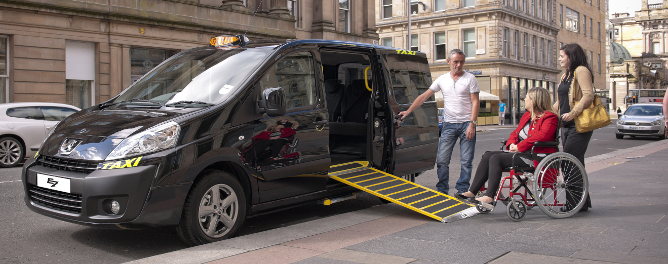
A recent report from the Law Commission has set out to review the legal framework in place regarding taxis and private hire vehicles. Disabled Motoring UK’s Helen Dolphin comments on the results of the report and how they affect accessibility for disabled people.
Bone of Contention
“One of the modes of transport that is often a bone of contention for disabled people is taxis and private hire vehicles (PHVs). Now I have to admit to doing my fair share of moaning, with good reason of course!
“Some of my worst taxi / PHV experiences include being told to pay extra at the end of a journey as I had my assistance dog with me, having taxi after taxi drive past because I was using my wheelchair and, of course, the unforgettable journey when a taxi driver just let go when he was pushing me up the ramp so I fell over backwards and cracked my head on the pavement!
“However, a project which was started in 2011 by the Law Commission with the aim of improving the legal framework relating to taxis and PHVs has finally been completed. The project was proposed by the Department for Transport, which has policy responsibility in this area. There have been a number of recommendations considered under the following headings:
Accessibility Training
“One of the key areas that the Commission looked into was accessibility. Following some of my experiences I was pleased to see that one of their recommendations is the introduction of mandatory disability awareness training for all taxi and private hire drivers. I am sure this will help to eliminate some of the ignorance that I often have to endure and I really hope this training will actually include showing drivers all the accessibility features in their cabs as, 50% of the time, I’m told they don’t have a swivel seat when they do!”
A Requirement to Display Complaints Information
“A further recommendation is that it’s made easier for people to complain, with how to complain being publicised a lot more widely. This sounds good in principle but I’m actually really fed up with complaining and I’d rather that the service was made considerably better so I didn’t have to.”
A New Obligation to Stop
“Having experienced myself the problem of taxis not wanting to stop when you’re a wheelchair user I was pleased that the Commission has recommended that licensing authorities should have the power to introduce a duty on taxis to stop when hailed.
“However, since they only have to stop if it’s “reasonable and safe to do so” I fear that we’ll always be told “it wasn’t safe” if a cab is ever challenged over why they didn’t stop. I know I may sound sceptical but anyone who has had to hide behind a wall while someone else hails a cab will understand where I’m coming from. Maybe it’s the dog and a chair that shouts “Don’t stop for me”. Whether this makes any difference is yet to be seen.”
Equality Act 2010
“I had hoped that the Law Commission would actually recommend that section 165 of the Equality Act 2010 was brought into force as this imposes on drivers of wheelchair accessible taxis and private hire vehicles duties to assist passengers who use wheelchairs – including not charging extra for the wheelchair.
“However, to my disappointment the Commission felt this did not fall within the scope of this project. On a more positive note the Commission has recommended that it should be a condition of licence for both drivers and operators that they comply with the provisions of the Equality Act 2010. This would enable a licensing authority to take action where a driver or dispatcher had, for example, overcharged a customer on the basis of a disability.”
Accessible Vehicles
“One of the main areas of debate in the consultation carried out by the Law Commission was whether there should be a separate licensing category for wheelchair accessible vehicles. After much consideration the conclusion they reached was there shouldn’t be – mainly because it would be very complicated and ignore the fact that the system needs to cater for many different types of disability. However, they have recommended that taxi rank design should comply with the Equality Act 2010 and that there should be information provided on the types of vehicle available which should be of some help.
“The Commission also made it clear that they do not consider quotas of wheelchair accessible vehicles to be suitable for a national licensing framework, nor do they propose to require private hire operators to have a particular proportion of wheelchair accessible vehicles in their fleets.
“Although I agree that a mixed fleet is better at meeting the needs of all disabled people, I would have liked to have seen a recommendation for a system to ensure there are enough accessible vehicles for the population in a particular area. I therefore do not see much change here to the problem many wheelchair users experience outside London of never being able to get an accessible taxi.
“However, a slight concession has been made in form of a recommendation that the Secretary of State should be able to impose specific accessibility requirements in respect of large private hire dispatchers, including in particular, quotas of disabled access vehicles.
“I’m pleased to see some of these recommendations but I still think the Commission could have gone further. The biggest disappointment to me is the lack of any quota as this, for many disabled people, is still the biggest issue – there just aren’t any wheelchair accessible vehicles.
“However, all these recommendations are just that – recommendations – and whether any of them are brought into force remains to be seen. I fear my moaning about taxis is not over just yet but if all the recommendations are brought in it may be significantly reduced.”
To read the full report, visit http://lawcommission.justice.gov.uk/areas/taxi-and-private-hire-services.htm


