
 France
 Germany
 Italy
Italy Spain
Spain Ireland
 Czechia
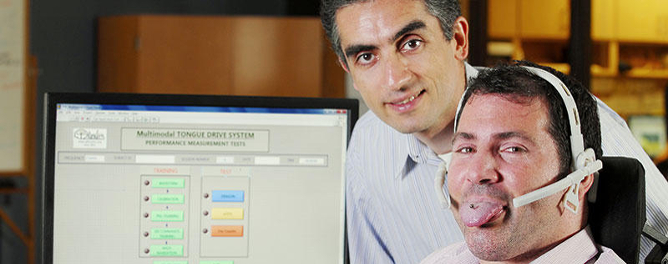
A research team at the Georgia Institute of Technology in America have developed an innovative new control system that allows users to control their wheelchair using only their tongue.
Since the tongue is unaffected by spinal injury and amazingly supple, it became the focus of the team in trying to find a new method of control. The system requires a small magnetic piercing through the tongue, which feeds information to sensors on the cheeks of the user which can detect even the tiniest of movements.
Exciting Development
Currently, users can control wheelchair movements by positioning their tongue within their mouth, however researchers aim for the system to eventually work by assigning a specific command to every tooth. This would allow people to use a combination of movements to carry out tasks by positioning their tongue at each tooth. The team is hoping that with further development, wheelchair users will be able to carry our a variety of tasks from changing the TV channel to dialling the telephone, all using the special piercing.
The system was tested on a group of 11 people with severe paralysis and found that they could carry out tasks up to three times faster than with other methods. Dr Ghovanloo, one of the researchers on the team, commented: “People will be able to do more and more effectively.”
New Wheelchair Technology
The system is currently still in research, with developers looking to fit the cheek sensors into a special dental brace which will make the invention more user friendly. The next step will be to have the system approved and made available to the public.
Director of charity Spinal Research, Dr Mark Bacon, thinks the new technology is a valuable and worthwhile avenue to explore. He says: “This method of wheelchair control will be beneficial to those with the most profound motor dysfunction. Capturing the tongues complex range of motion to command assistive devices will be hugely advantageous.”


